
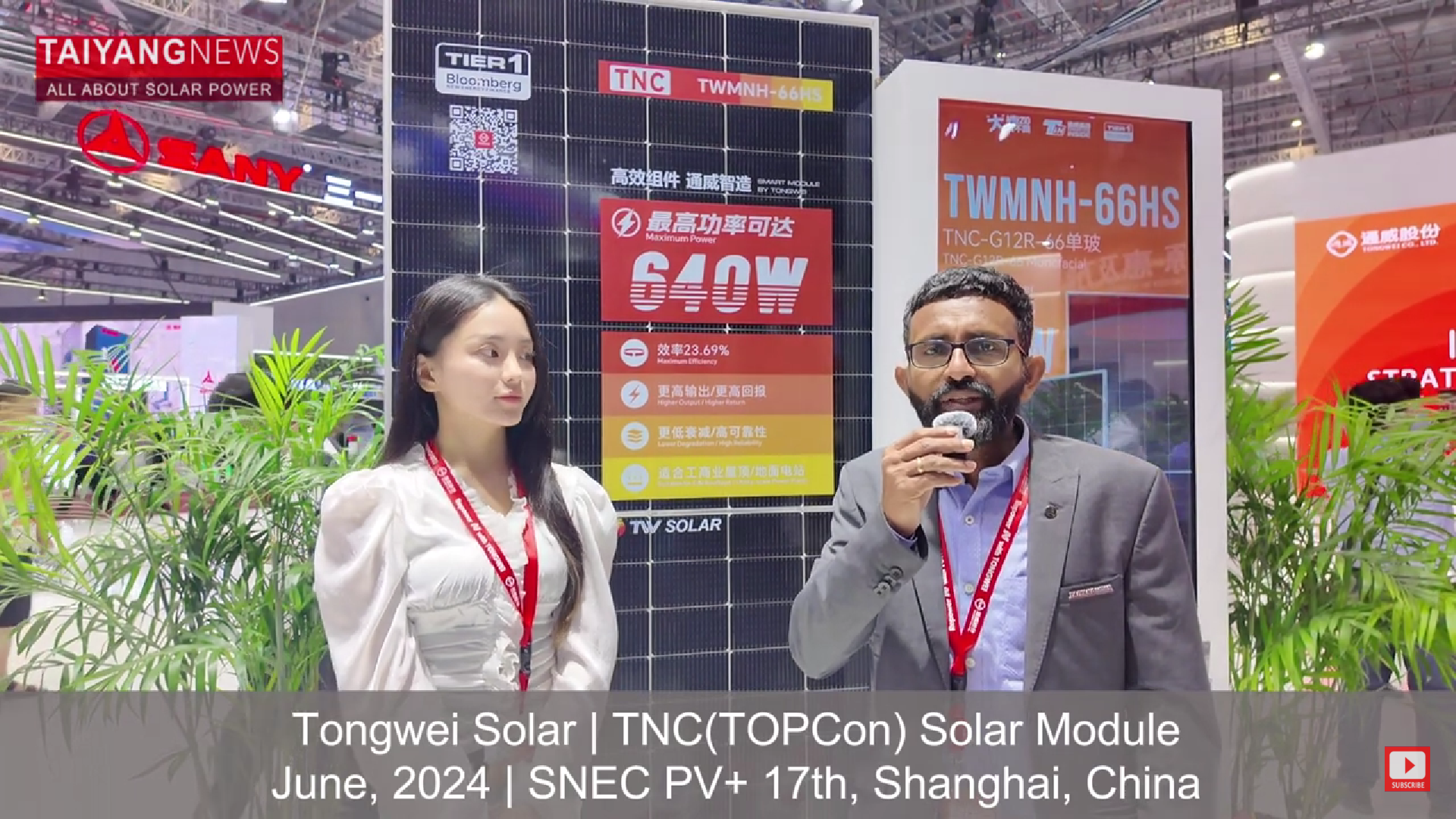
Tongwei Solar is a vertically integrated photovoltaic (PV) manufacturing company with a presence in polysilicon, wafers, solar cells, and PV modules. Currently, the company has a production capacity of 450,000 tons/year for polysilicon, 20 GW/year for monocrystalline wafers, 20 GW/year for solar cells, and 75 GW/year for PV modules. Recently, Tongwei exhibited the latest expansions in its TNC and THC cell technology-based module portfolio at SNEC 2024. Tongwei calls its n-TOPCon cell structure TNC, while its heterojunction (HJT) cell structure is called THC.
Speaking to TaiyangNews, the company highlighted its latest TNC cell-based monofacial TNC-G12R-66 series and THC cell-based bifacial THC-G12-66 series modules.
TNC module for C&I and utility
The company’s single-glass TWMNH-66HS series TNC module under the G12R half-cell category boasts a power output of up to 640 W and an efficiency of 23.69%. The latest model in the TNC-G12R-66 series demonstrates a direct power increase of 15 W, rising from 625 W to 640 W, and an efficiency boost from 23.1% to 23.69% compared to its previous models. The module is made up of 132 half-cells of 182 x 210 mm (G12R) size in dimensions of 2,382 x 1,134 x 35 mm, noted the company.
Tongwei says that the improvement in power and efficiency underscores its continuous technological improvements at the cell level, resulting in a mass-scale TNC efficiency of 26.5%+. This high cell efficiency can be attributed to the adoption of multiple processes like the tube type PECVD PE-TOPCon technology, in which all the steps—tunneling oxide (Tox) as well as polysilicon deposition and in-situ doping—are accomplished using the PECVD route. Alongside the improvement in the rear-side passivation layer, the company also implemented multiple metal contact reduction (MCR) technologies like selective emitter (SE) and super multi-busbar (SMBB) metallization technology to improve cell efficiency. The adoption of selective laser texturing technology (SLTT) on the wafer side and non-destructive cell slicing technology also contributed to improved cell efficiency, added the company. Tongwei substantiated the module’s long-term durability and reliability by offering 12 years of product warranty and a linear power warranty of up to 30 years, which is negotiable upon request.
THC module for utility
The company also showcased its 210 x 210 mm HJT cell technology route progress with the TWMHF-66HD series module, featuring a 765.18 W power output and 24.63% efficiency. This module, with dimensions of 2,384 x 1,303 x 33 mm, is based on THC cells with 26.49% mass-scale cell efficiency. The company emphasized that 26.49% mass-scale THC cell efficiency can be attributed to the implementation of the microcrystalline silicon layer over the amorphous silicon i-layer on both sides. On the other hand, the successful incorporation of busbarless metallization technology (0BB) with copper electroplating boosted module efficiency to 24.63%, added Tongwei. The copper electroplating process is a technique where a copper layer is deposited onto the solar cell surface, reducing shading and improving the cell’s overall efficiency. The model comes with a default product warranty of 15 years and 30 years of power output, while a longer warranty can be availed if needed.